
Methodology
Status: evidence catalog only. Operational trust is Not evaluated. These are evaluations, not certifications. NoetIQs Verify assigns no score, ranking, badge, or certification. Operational trust stays Not evaluated until a scoped assessment exists, and that assessment is not a product-wide badge.
Markets
Accounting and finance, Customer Support AI, and HR and recruiting AI are in scope. Accounting and finance is the published catalog. Customer Support AI is the next market, and HR and recruiting AI follows it. Sales and go-to-market AI and Legal AI are deferred. Government and defense AI is deferred pending the owner's ethics check. This page adds no tool records. L1 through L5, Insufficient evidence, no scores or rankings, default-closed source rights, and OSINT-first research apply unchanged in every market.
HR and recruiting AI is a regulated, high-risk area, including NYC Local Law 144, the Colorado AI Act, and the EU AI Act. A claim about a bias audit or legal compliance must cite the public audit or other public source directly. That citation must never be read as a compliance determination. Verify does not decide that a product is compliant, fair, or unbiased.
Evidence levels (applied per capability)
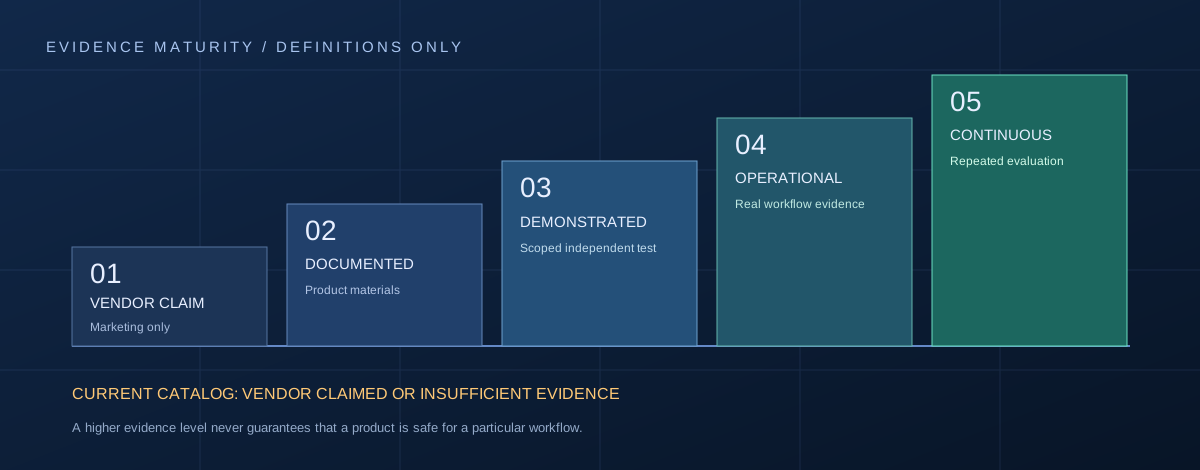
- L1 Vendor claimed: the vendor's own marketing says it does this.
- L2 Documentation verified: product documentation, release notes or help pages describe how it works.
- L3 Independently demonstrated: NoetIQs or a named third party watched it work on realistic data.
- L4 Operationally validated: confirmed in real use by identified practitioners over at least one close cycle.
- L5 Continuously evaluated: re-tested on a schedule, with results published.
- Insufficient evidence: we couldn't confirm even a vendor claim.
Evidence strength does not establish product reliability or safety. Every product's operational trust status remains Not evaluated until appropriately scoped testing is completed. "Insufficient evidence" describes our available research, not necessarily the total evidence that exists. There is no score, ranking, or badge.
Source dates and traceability
A source-reviewed date records when public text was inspected. It is not a product-test date or a promise that a feature is currently available. Each profile has anchored, scoped capability claims, source links and review notes in the dated profile record. The article record distinguishes vendor announcements (L1) from implementation instructions read (L2). Neither establishes L3 or operational validation. Inaccessible or ambiguous evidence is removed or marked insufficient; absence from a system filter is not a finding of incompatibility.
Historical proposal: scoring dimensions (100 points)
Historical proposal only. Not active policy. The dimensions below are an earlier public proposal. Verify keeps operational trust at Not evaluated and does not authorize scores, rankings, badges, or a scoring engine. Nothing in the catalog uses these points.
- Functional reliability, 25: does it do the task correctly and consistently, including edge cases?
- Evidence & auditability, 20: does it keep a trail of what went in, what came out, and who approved it?
- Human oversight, 20: can a reviewer approve, override or reject before anything posts or pays?
- Security & data governance, 15: data handling, access control, retention, published attestations.
- Integration, 10: depth and reliability of the connection to the ledger or ERP.
- Transparency, 10: are pricing, limits, model use and failure modes clearly disclosed?
Governed autonomy and hard-stop policy
Automation can be appropriate when authorized policies, transaction limits, exception escalation, logging and rollback safeguards are demonstrably effective. Human review is particularly important for novel, exceptional, material and judgment-intensive events; a manual click is not by itself evidence of adequate governance.
A proposed hard stop applies to material deficiencies in authorization, segregation of duties, traceability, exception handling, reversibility or security for the specific evaluated workflow. No such findings are assigned before testing. Missing evidence means Not evaluated, not failure or approval.
Integration evidence is separate
Native integration, third-party connection, import/export and migration-only support must not be treated as equivalent. A vendor mentioning an accounting system does not establish a working ongoing integration. Directory compatibility is preliminary until its integration type and source are identified.
What this is not
This is not a SOC report, an attestation, a certification, a compliance determination, or legal, accounting, or employment-law advice. Citing a public bias audit or a legal source is not a compliance determination. Always test on your own data.